
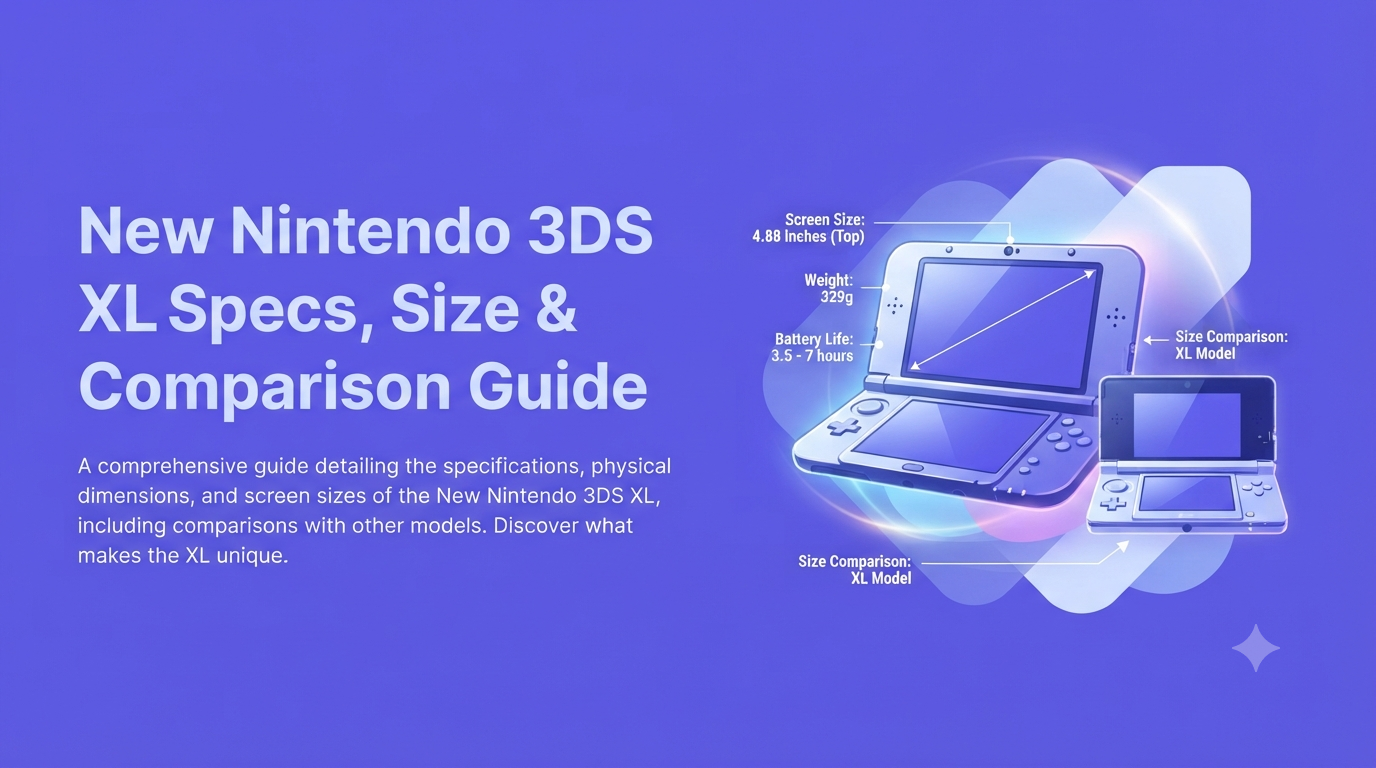
The New Nintendo 3DS XL is an upgraded version of Nintendo’s popular handheld gaming system, offering improved performance, additional controls, better 3D technology, and enhanced compatibility compared to the original Nintendo 3DS XL. Released in 2015 for most international markets, it introduced several hardware improvements while maintaining full support for the extensive Nintendo 3DS software library.
Designed for both casual and dedicated players, the New Nintendo 3DS XL features a larger dual-screen display, faster processing hardware, integrated NFC support for amiibo, additional shoulder buttons, and a small C-Stick that expands control options in compatible games.
One of the biggest improvements is the enhanced stereoscopic 3D system. Using face-tracking technology, the console adjusts the viewing angle in real time, making the 3D effect much more stable than on earlier Nintendo 3DS models.
The system is compatible with thousands of Nintendo 3DS and Nintendo DS games, making it one of the most versatile handheld consoles Nintendo has released. It also supports digital downloads through the Nintendo eShop, local wireless multiplayer, StreetPass, SpotPass, and various multimedia applications.
Beyond gaming, the New Nintendo 3DS XL has become popular among collectors, retro gaming enthusiasts, developers, and hardware hobbyists. Its repairable design, active modding community, and broad software compatibility have helped it remain relevant years after its original release.
Quick overview and who it’s for
The New Nintendo 3DS XL is ideal for players who want the most feature-rich version of Nintendo’s classic dual-screen handheld without moving to a completely different gaming platform. It combines a larger display with improved performance while preserving compatibility with the vast majority of Nintendo 3DS and Nintendo DS titles.
Compared to the original Nintendo 3DS XL, the newer model offers a faster processor, additional RAM, improved wireless performance, NFC functionality for amiibo support, and two extra shoulder buttons known as ZL and ZR. It also introduces the C-Stick, giving players additional camera and control options in supported games.
The improved hardware allows the console to load software more quickly, switch between applications faster, and run a small number of games that require the New Nintendo 3DS family. Titles such as Xenoblade Chronicles 3D and several enhanced applications were specifically designed to take advantage of the upgraded hardware.
Collectors also value the New Nintendo 3DS XL because Nintendo released numerous limited-edition designs featuring popular franchises such as Pokémon, The Legend of Zelda, Fire Emblem, Super Nintendo, Monster Hunter, and Animal Crossing. Many of these special editions have become sought-after collector’s items
Even years after production ended, the New Nintendo 3DS XL remains one of the most capable handheld consoles in the Nintendo 3DS family. Its combination of performance improvements, comfortable ergonomics, enhanced controls, and broad game compatibility continues to make it a popular choice for both new buyers and longtime Nintendo fans.
Key technical specifications
The New Nintendo 3DS XL features upgraded hardware that delivers faster performance, smoother multitasking, and improved gaming compared to the original Nintendo 3DS XL. It combines a more powerful processor, additional memory, built-in NFC support, and enhanced wireless capabilities while maintaining compatibility with nearly the entire Nintendo 3DS game library.
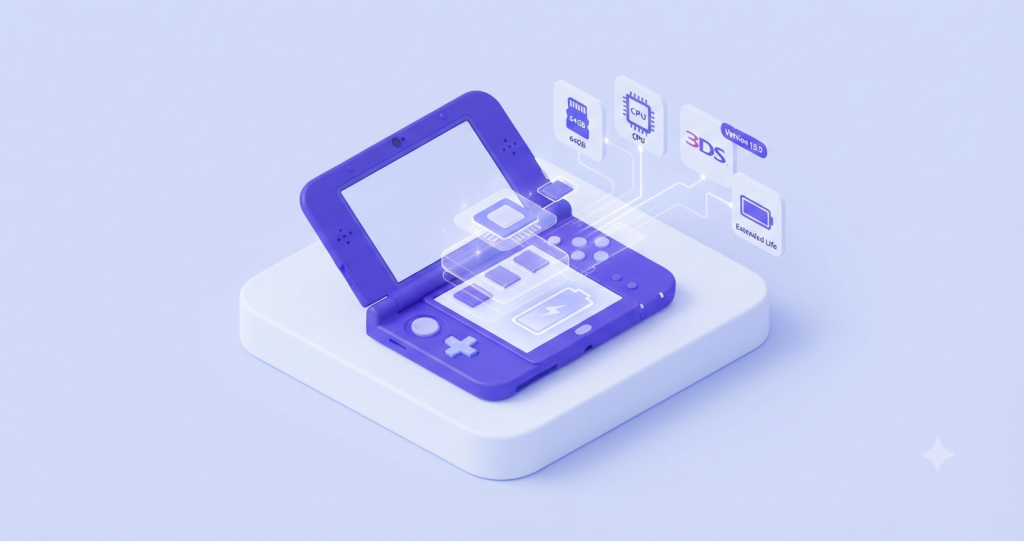
The console also supports stereoscopic 3D with face tracking, expandable microSD storage, dual cameras, motion sensors, local wireless communication, and amiibo functionality. These upgrades make it one of the most capable systems in the Nintendo 3DS family.
CPU, GPU and performance summary
The New Nintendo 3DS XL uses a custom ARM-based processor paired with the Digital Media Professionals PICA200 GPU. Compared to earlier Nintendo 3DS models, the upgraded hardware offers faster loading times, smoother menu navigation, and improved overall responsiveness.
The dedicated graphics processor supports stereoscopic 3D rendering, texture mapping, lighting effects, and other visual enhancements optimized for the console’s dual-screen display. The additional processing power also enables a small number of New Nintendo 3DS-exclusive games and improves performance in supported titles.
Key technical specifications
The New Nintendo 3DS XL features upgraded hardware compared to the original Nintendo 3DS and Nintendo 3DS XL, making it one of the most capable handheld consoles in the Nintendo 3DS family. Nintendo focused on improving processing power, memory, wireless capabilities, and overall responsiveness while keeping full compatibility with almost the entire Nintendo 3DS software library.
Although the console retains the familiar dual-screen clamshell design, its internal hardware received several meaningful upgrades. These improvements reduce application loading times, make the HOME Menu more responsive, improve web browsing performance, and enable support for a small number of games that require the newer hardware.
The system combines a custom ARM-based processor, dedicated graphics hardware, increased memory, integrated NFC support, improved stereoscopic 3D, and expandable storage through microSD cards. Together, these components provide a balanced gaming experience that remains impressive for a handheld console released in the mid-2010s.
CPU, GPU and performance summar
The New Nintendo 3DS XL is powered by a custom ARM-based processor designed specifically for the Nintendo 3DS platform. Compared to the original Nintendo 3DS XL, the upgraded processor delivers improved system responsiveness, faster application loading, and better multitasking performance.
Nintendo increased the available processing power while maintaining compatibility with existing software. This means older Nintendo 3DS games continue to run correctly, while newer applications can take advantage of the enhanced hardware where supported.
The console uses multiple processor cores to divide system tasks efficiently. The main processor handles game execution, while additional cores manage operating system functions, background services, wireless communication, and other system operations.
Graphics processing is handled by the Digital Media Professionals PICA200 GPU, a graphics processor developed specifically for the Nintendo 3DS family. It supports hardware-accelerated stereoscopic 3D graphics without requiring special glasses and includes features such as programmable lighting, texture mapping, shader effects, and anti-aliasing.
Although the hardware is modest compared to modern handheld gaming devices, it was carefully optimized for the Nintendo 3DS display resolution and software library. This optimization allows games to deliver stable performance while maintaining efficient power consumption.
The improved processor offers several practical advantages during everyday use. System menus open more quickly, digital games launch faster, and switching between applications feels noticeably smoother than on the original Nintendo 3DS models.
Software downloads, system updates, and internet-based features also benefit from the additional processing power. Web pages render more efficiently, background tasks complete more quickly, and the overall operating system feels more responsive.
Memory, storage and external media
The New Nintendo 3DS XL includes more system memory than earlier models, allowing for faster application loading and smoother multitasking. It stores digital games, updates, save data, and screenshots on a removable microSD or microSDHC card located beneath the rear cover.
Physical games are played using Nintendo 3DS Game Cards, while the console also supports backward-compatible Nintendo DS game cartridges. This combination of expandable storage and physical media gives players flexibility in managing their game library.
Wireless, sensors and special chips
The New Nintendo 3DS XL supports Wi-Fi for online gaming, digital downloads, and system updates, as well as local wireless communication for multiplayer gaming. It also features built-in NFC for amiibo compatibility and infrared (IR) communication for supported applications.
The console includes an accelerometer, gyroscope, and face-tracking camera that work together to improve motion controls and stabilize the glasses-free 3D effect. These hardware features provide a smoother and more immersive gaming experience than previous Nintendo 3DS models.
Dimensions, design and ergonomics
Image placeholder: Front, side, and folded view of the New Nintendo 3DS XL showing dimensions and overall design.
The New Nintendo 3DS XL features a comfortable clamshell design with larger screens and rounded edges for extended gaming sessions. Its balanced weight and ergonomic shape make it easier to hold for long periods, while the foldable design protects both displays when the console is closed.
Nintendo also refined the button placement and added a C-Stick and ZL/ZR buttons, improving control without significantly increasing the console’s size.
Physical dimensions, weight and hinge design
The New Nintendo 3DS XL measures approximately 160 × 93.5 × 21.5 mm (6.3 × 3.68 × 0.85 inches) and weighs about 329 grams (11.6 ounces), making it larger than the standard New Nintendo 3DS but still highly portable.
Its durable clamshell hinge allows the upper display to open smoothly and remain stable at multiple viewing angles. The hinge also helps protect the screens, buttons, and touchscreen from scratches and damage while the console is being carried or stored.
The combination of its larger size, sturdy hinge, and well-balanced weight provides a comfortable grip, making the New Nintendo 3DS XL one of the most ergonomic handheld consoles in the Nintendo 3DS family.
Button and control layout (face buttons, shoulder buttons, C-Stick)
The New Nintendo 3DS XL features a familiar control layout with several improvements over earlier models. The front of the console includes the A, B, X, and Y face buttons, a Circle Pad, D-pad, START, SELECT, and HOME buttons for easy navigation and gameplay.
At the top, the console includes the standard L and R shoulder buttons along with the additional ZL and ZR buttons, providing extra controls for compatible games. A small C-Stick is positioned above the face buttons and is commonly used for camera movement and other secondary controls.
This expanded layout gives players more precise input options while maintaining the comfortable design of the Nintendo 3DS family.
Build materials, finishes and available color variants
The New Nintendo 3DS XL features a durable plastic shell designed for everyday portability. Its sturdy clamshell construction helps protect the dual screens and internal components during travel and regular use.
Nintendo released the console in several matte and glossy finishes, depending on the region and edition. Over its lifespan, it was available in colors such as Black, Red, Blue, Metallic Black, Metallic Blue, Pearl White, and Pink, along with numerous limited-edition designs.
Special editions inspired by franchises such as The Legend of Zelda, Pokémon, Super Nintendo, Fire Emblem, Animal Crossing, and Monster Hunter have become particularly popular among collectors for their unique artwork and limited availability.
Display, audio and input
The New Nintendo 3DS XL features a dual-screen design that combines a large autostereoscopic upper display with a responsive resistive touchscreen. This setup allows games to use one screen for gameplay while the other displays maps, menus, inventory, or additional controls.
Nintendo also improved the 3D experience by introducing Super-Stable 3D, which uses face-tracking technology to keep the stereoscopic effect more consistent as the player moves.
Upper and lower screens: sizes, resolutions and 3D feature
The upper screen measures 4.88 inches with a resolution of 800 × 240 pixels, displaying 400 × 240 pixels per eye when the 3D effect is enabled. This glasses-free 3D display creates a sense of depth without requiring special eyewear.
The lower touchscreen measures 4.18 inches and has a resolution of 320 × 240 pixels. It is used for menus, touch controls, drawing, and gameplay features supported by Nintendo 3DS titles.
One of the biggest improvements in the New Nintendo 3DS XL is Super-Stable 3D. Using an infrared face-tracking camera, the console automatically adjusts the viewing angle, making the 3D effect more stable and reducing image blur compared to earlier Nintendo 3DS models.
Touchscreen, stylus and touch input behavior
The New Nintendo 3DS XL features a 4.18-inch resistive touchscreen that responds to pressure rather than capacitive touch. It supports navigation, menu selection, drawing, handwriting, and touch-based gameplay in compatible titles.
A built-in stylus is stored inside the console, providing accurate input for games and applications that require precise control. While the touchscreen can also be used with a finger, the stylus offers greater accuracy for detailed interactions.
Speakers, headphone output and microphone
The console includes stereo speakers positioned beside the upper display, delivering clear audio for games, videos, and system applications. The built-in sound provides good volume and directional effects for handheld gaming.
A standard 3.5 mm headphone jack allows users to connect wired headphones or external speakers for private listening and improved audio quality. The built-in microphone supports voice recording, voice chat in compatible software, and games that use sound or speech as part of the gameplay.
Controls, cameras and extra hardware
The New Nintendo 3DS XL introduces several hardware improvements that expand its control options beyond previous Nintendo 3DS models. In addition to the standard buttons and touchscreen, it includes a C-Stick, ZL/ZR shoulder buttons, built-in cameras, motion sensors, and NFC support for amiibo.
These additions improve gameplay in supported titles and provide more precise control for camera movement, action games, and system features.
Circle Pad, C-Stick, ZL/ZR and additional input changes
The Circle Pad remains the primary analog control, offering smooth and accurate movement in compatible games. It is positioned above the D-pad for comfortable access during gameplay.
One of the biggest upgrades is the addition of the C-Stick, a small secondary analog control located above the face buttons. It is commonly used for camera control, aiming, and other secondary functions in supported games.
The console also adds dedicated ZL and ZR shoulder buttons alongside the standard L and R buttons. These extra inputs provide additional control options without requiring external accessories.
Together, the Circle Pad, C-Stick, and ZL/ZR buttons give the New Nintendo 3DS XL a more versatile control layout, making it better suited for modern gameplay and titles designed specifically for the New Nintendo 3DS family.
Cameras, AR features and motion sensors
The New Nintendo 3DS XL includes three built-in cameras: one front-facing camera and two rear cameras that work together to capture 3D photos and videos. These cameras also support compatible games and system applications.
The console features Augmented Reality (AR) capabilities, allowing supported software to combine virtual objects with the real world using the rear cameras and Nintendo AR Cards.
For motion-based gameplay, the system includes a built-in accelerometer and gyroscope. These sensors detect movement, rotation, and console orientation, enabling intuitive controls in racing, puzzle, and action games.
Ports, media and connectivity
The New Nintendo 3DS XL includes a variety of ports and wireless features for gaming, storage, charging, and communication. It supports Nintendo 3DS and Nintendo DS Game Cards, expandable microSD storage, and built-in Wi-Fi for online services and digital downloads.
The console also features infrared (IR) communication, NFC for amiibo compatibility, and local wireless multiplayer, allowing players to connect with nearby Nintendo 3DS systems without an internet connection. These connectivity options make the handheld versatile for both offline and online gaming experiences.
Game cartridge slot, SD card access and external ports
The New Nintendo 3DS XL includes a dedicated Game Card slot that supports both Nintendo 3DS and Nintendo DS game cartridges. This backward compatibility allows players to enjoy a large library of games from both handheld systems.
Digital content is stored on a microSD or microSDHC card, which is located beneath the removable back cover. The console also features a charging port, a 3.5 mm headphone jack, a stylus slot, and a game card slot, providing all the essential connections needed for gaming and media storage.
Wi-Fi, infrared, NFC/amiibo and local communication
The New Nintendo 3DS XL supports 802.11 Wi-Fi, allowing users to access online multiplayer, download digital games, receive system updates, and use internet-based features.
It also includes infrared (IR) communication for compatible software and accessories, along with built-in NFC that enables direct support for amiibo figures without requiring an external reader.
For nearby multiplayer, the console supports local wireless communication, making it easy to connect with other Nintendo 3DS systems for cooperative and competitive gameplay. Features such as StreetPass and SpotPass also use the system’s wireless capabilities to exchange game data and receive notifications automatically.
Performance, compatibility and software features
The New Nintendo 3DS XL delivers improved performance over earlier Nintendo 3DS models thanks to its faster processor and additional memory. These hardware upgrades provide quicker loading times, smoother system navigation, and better multitasking while maintaining compatibility with the vast majority of Nintendo 3DS software.
In addition to improved performance, the console includes features such as Super-Stable 3D, built-in NFC for amiibo support, expanded controls with the C-Stick and ZL/ZR buttons, and enhanced wireless capabilities. These improvements make it the most feature-rich model in the Nintendo 3DS family.
Backward compatibility and New-3DS-only titles
The New Nintendo 3DS XL is fully compatible with nearly all Nintendo 3DS, Nintendo DS, and Nintendo DSi software, allowing players to enjoy thousands of games from previous handheld generations. However, as with other Nintendo 3DS models, it does not support Game Boy Advance cartridges or Nintendo DS games that require the original GBA slot.
The upgraded hardware also supports a small number of New Nintendo 3DS-exclusive titles that cannot run on the original Nintendo 3DS or Nintendo 3DS XL. Games such as Xenoblade Chronicles 3D were designed specifically for the faster processor and additional memory available in the New Nintendo 3DS family.
System features: enhanced 3D, face tracking and controller mapping
One of the biggest upgrades in the New Nintendo 3DS XL is Super-Stable 3D, which uses an infrared face-tracking camera to automatically adjust the viewing angle. This keeps the glasses-free 3D effect more stable and reduces image blur as the player moves.
The console also introduces the C-Stick and ZL/ZR shoulder buttons, giving supported games additional control options without requiring external accessories. Some titles allow these inputs to be used for camera movement, aiming, or customizable controller mapping, providing a more comfortable gameplay experience.
Emulation and homebrew performance considerations
The New Nintendo 3DS XL is a popular choice among enthusiasts because its upgraded processor and additional memory offer better performance than earlier Nintendo 3DS models. The improved hardware allows compatible homebrew applications to load more quickly and provides smoother performance in software designed to take advantage of the newer system.
Many community-developed applications and emulators perform better on the New Nintendo 3DS family due to the increased processing power. However, performance varies depending on the application, optimization, and the software’s hardware requirements.
Battery and power
The New Nintendo 3DS XL is powered by a rechargeable lithium-ion battery that provides several hours of gameplay on a single charge. Actual battery life depends on factors such as screen brightness, wireless usage, 3D settings, game type, and overall system activity.
The console is built to balance performance and power efficiency, making it suitable for both short gaming sessions and extended portable play.
Battery capacity and typical runtime estimate
The New Nintendo 3DS XL uses a 1,750 mAh rechargeable lithium-ion battery. Under typical conditions, Nintendo estimates a battery life of approximately 3.5 to 7 hours when playing Nintendo 3DS games.
For Nintendo DS games, the battery can last around 7 to 12 hours, as these titles generally require less processing power.
Charging the battery from empty to full usually takes about 3.5 hours when the console is not in use. Lower screen brightness, disabling wireless features, and reducing the 3D effect can help extend battery life during gameplay.
Charging, power adapters and battery replacement notes
The New Nintendo 3DS XL charges through Nintendo’s standard charging port and is compatible with official Nintendo 3DS family AC adapters. A full charge typically takes around 3.5 hours when the system is powered off.
The rechargeable battery is located beneath the removable back cover and can be replaced if it no longer holds a sufficient charge. Before replacing the battery, always power off the console and use a compatible replacement designed for the New Nintendo 3DS XL.
Proper charging habits, avoiding extreme temperatures, and using reliable accessories can help extend the battery’s lifespan.
Repair, maintenance and common replacements
The New Nintendo 3DS XL is relatively easy to repair compared to many modern handheld consoles. Several components, including the battery, Circle Pad, buttons, speakers, and displays, can be replaced with the proper tools and replacement parts.
Regular cleaning, careful handling, and timely replacement of worn components can help keep the console in good working condition and extend its lifespan.
Common hardware issues to watch for
Over time, the New Nintendo 3DS XL may develop common wear-related issues such as a worn Circle Pad, unresponsive buttons, weak battery performance, scratched screens, or a loose hinge.
Other issues can include damaged charging ports, speaker problems, touchscreen calibration errors, and cracked shells caused by accidental drops. Identifying these problems early can make repairs simpler and help prevent additional damage.
Tools, replacement parts and repair prep
Basic repairs typically require a Phillips #00 screwdriver, a plastic opening tool, tweezers, and an anti-static wrist strap for safe handling of internal components.
Before beginning any repair, power off the console, remove the microSD card and game cartridge, and disconnect the battery if possible. Using high-quality replacement parts and following an organized repair process can reduce the risk of damaging internal hardware.
Conclusion
The New Nintendo 3DS XL remains a favorite handheld console thanks to its larger display, improved performance, built-in NFC support, and enhanced controls. Whether you’re comparing it with other Nintendo 3DS models or checking its specifications before buying, understanding its hardware and features helps you choose the right system for your gaming needs.
For users looking to unlock additional features and customize their handheld, Luma3DS is one of the most widely used custom firmware solutions for the Nintendo 3DS family. At Luma3DS, you’ll find step-by-step installation guides, troubleshooting tutorials, and the latest resources to help you get the most out of your New Nintendo 3DS XL safely and confidently.
FAQs
What is the difference between the New Nintendo 3DS XL and the original 3DS XL?
The New Nintendo 3DS XL features a faster processor, more memory, Super-Stable 3D, built-in NFC for amiibo support, a C-Stick, and additional ZL/ZR buttons. These upgrades improve performance and add support for a small number of New Nintendo 3DS-exclusive games.
Does the New Nintendo 3DS XL play Nintendo DS games?
Yes. The console is backward compatible with most Nintendo DS and Nintendo DSi games, in addition to the full Nintendo 3DS game library.
Does the New Nintendo 3DS XL support amiibo?
Yes. It has built-in NFC functionality, allowing compatible amiibo figures to be scanned directly without needing an external reader.
How long does the battery last?
Battery life typically ranges from 3.5 to 7 hours for Nintendo 3DS games and 7 to 12 hours for Nintendo DS games, depending on screen brightness, wireless usage, and game type.
Can the battery be replaced?
Yes. The rechargeable battery is located beneath the rear cover and can be replaced with a compatible battery using basic tools.
Latest Post